


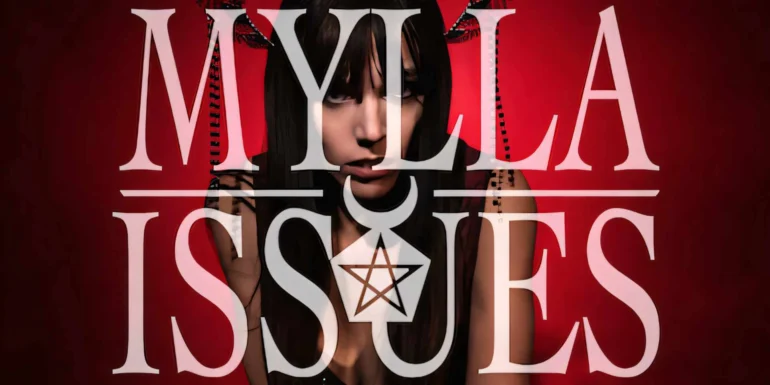
Today, I’m very excited and genuinely honored to introduce MYLLA ISSUES, an Italian darkwave/EBM artist from Rome. Not only she blends synth, darkwave and dream-pop influences, but she also creates atmospheric and emotional music with a strong ’80s edge. Absolutely everything I love ! Her debut album « MY(RAGE) », released in June 19th, 2026 on Wave Records, is a powerful first milestone in her incredible journey.
First of all, I want to say what a real honor it is for me to get the opportunity to realize this interview with you. There is nothing more exhilarating for me as a music journalist than getting the chance to interview an artist I love so passionately! I fell in love with your album from the first time I listened to it : the design of the cover art, the photos, the melodies and lyrics of the songs.
Thank you so much! I'm truly delighted to be doing this interview with you. I'd also like to thank you not only for giving me this opportunity, but also for the wonderful review you wrote of my album. It really means a lot to me!
1. You describe yourself as a “witchy” singer-songwriter. How does that spiritual or esoteric lens shape not just your lyrics and visuals, but the way you approach sound design and performance?
Yes, I'd say that the "witchy" side really defines the overall vibe of my project. For me, though, it's never been just an aesthetic, it's something that genuinely belongs to who I am. I've been fascinated by the esoteric, witchcraft, and the paranormal ever since I was a child, so it naturally found its way into my music. It's a recurring thread throughout my work. While not every song is about those themes, many of my lyrics are influenced by those kinds of atmospheres.
I think you can hear it in the sound of the music, and of course you can see it in the visual identity as well. For example, the concept behind the album was also inspired by classic horror cinema. Visually, I drew inspiration from films like Suspiria and Deep Red by Dario Argento, so you could definitely say that this witchy imagery accompanies almost every aspect of the project.
It also extends to my live performances. You can see it in my stage outfits, which often evoke those esoteric, witch-like, or vampiric vibes, and in the atmospheres I love to create on stage. I always try to transport people into a world that feels dreamlike, ethereal, and a little otherworldly, something that isn't entirely tangible.
2. In a genre scene that often draws from occult or gothic aesthetics, what does “witchy” mean to you personally, and how do you ensure it feels authentic rather than performative?
For me, I know it's authentic because it's a world I've genuinely been fascinated by for as long as I can remember. It's not something I've adopted for aesthetics, it's always been part of who I am. I think people can usually tell the difference, there are artists who might embrace a certain image, but then you listen to their lyrics and there's no real connection to that world. In my case, I believe it comes through naturally, both in my attitude and in my songwriting.
A lot of my lyrics are inspired by my dreams. Ever since I was a child, I've had very vivid dreams with paranormal, occult, or mysterious imagery. Those themes have always fascinated me, and that interest also comes from my family, it's something that was passed down to me in a way, so it has always felt very familiar.
What draws me to these subjects is that they're full of mystery, some questions that probably can never be answered with complete certainty, and I find that incredibly inspiring from a creative point of view. So I think the authenticity comes across naturally. You can hear it in my lyrics, or even just by having a conversation with me about these topics. My music reflects who I really am, and I believe people can genuinely feel that.
3. Your lyrics draw heavily from the dream world — visions, inexplicable sensations, and hidden meanings. Can you walk us through how a specific dream or liminal experience made its way into a song on (MY)RAGE?
The first song that comes to mind is definitely "Haunter". It's probably the track that's most directly inspired by my dreams. In the lyrics, I talk about a spirit that haunts someone, and throughout my life I've had many dreams with that kind of unsettling atmosphere. I'm sure all the horror films I've watched have also influenced those images.
"Haunter" is probably the darkest song on the record, both lyrically and conceptually. Even the title suggests the idea of a presence that follows you or refuses to leave you, so it's the track that's most closely connected to that dreamlike and paranormal world.
Another example is "Hollow Way." That song is a little different because it's not so much about dreams themselves, but about memories and emotions connected to the past. I imagined myself as a child, going to visit my grandparents in the city, so it's filled with nostalgia and distant memories. But dreams are still part of it, because I often dream about my childhood.
Sometimes I find myself back in the house where I grew up, even in my nightmares. It's strange and unsettling, but at the same time incredibly inspiring. I'd also mention "Creature of June." That song is very visual, almost cinematic. It's dreamy and ethereal, but it also has a slightly creepy atmosphere, and I think that comes across in the music video as well.
Then there's "Two Sisters," which tells the story of a figure suspended between dreams and reality, existing in that liminal space that has always fascinated me. But if I had to choose the song that's most directly based on one of my dreams or, more accurately, one of my nightmares, it would definitely be "Haunter."
4. What role does that subconscious space play in your creative process?
I would actually say it plays the central role in my creative process. I rarely write songs that are directly autobiographical. Even when they are inspired by personal experiences, they're usually filtered through memories that have been reshaped over time, or memories that come back to me in dreams and take on a completely different perspective, often a darker or more unsettling one.
When I describe my project, I often use words like witchy because there are definitely esoteric and occult influences, but even more than that, I think it's deeply rooted in the dream world, in hidden meanings, unexplained feelings, and that liminal space between reality and imagination.
I also realize that many of my lyrics aren't straightforward, they're intentionally symbolic rather than literal. I like leaving room for interpretation, because everyone can connect with them in a different way and project their own experiences onto them. So yes, I would say the subconscious isn't just part of my creative process, it's really where everything begins. It's the foundation of almost everything I write.
5. Many synth/darkwave artists explore nostalgia or retrofuturism. For you, the 80s references feel filtered through something more personal and ritualistic. How do you balance homage to that era with a contemporary, forward-looking vision?

Yes, absolutely. Alongside the dreamlike and esoteric side of my music, there's also a strong connection to the sound of the 1980s, especially in some of my songs. What's interesting is that I never actually lived through that decade, I wasn't born yet, but I've always been fascinated by it. A lot of that comes from my parents: the stories they told me and, above all, the music they introduced me to when I was growing up. Those influences became a very important part of my musical and artistic education.
For me, the '80s influence is mainly musical rather than visual. Visually, my aesthetic is much more connected to the witchy and occult side of my project, but sonically, especially in tracks like "Party!!!(in the 80s)" you can definitely hear those references. I find it fascinating that I feel nostalgic for a time I never actually experienced. It's a very specific kind of nostalgia, and I almost think it's something worth studying. Those sounds have become part of me, even though they belong to a past that isn't mine. I naturally combine those sonic influences with much more personal themes like dreams, hidden meanings, emotions, and the subconscious. I don't really think about balancing those two worlds; it just happens instinctively.
Since those influences are part of who I am as an artist, they blend with my own inner world and end up creating something that feels personal, contemporary, and, hopefully, forward looking rather than simply nostalgic.
6. Your debut album "MY(RAGE)" seems to channel a lot of emotional intensity through melancholic synths, hypnotic basslines, and ritualistic energy. What does the title represent for you — personal rage, collective fury, catharsis, or something more esoteric?
I chose the title of my album through a kind of wordplay, because it carries multiple meanings. The main one is definitely “My Rage” as in anger and I wanted to explore different kinds of rage. The central idea behind it is about transforming anger into something positive, rather than letting it become destructive. It’s about turning something initially negative into energy, something vital that can be channeled into art and music. In my case, that rage can be quite personal. It can come from periods like adolescence, when I often struggled to fully express who I was and felt a bit different from others, but it can also represent something more universal, smaller or larger traumas that anyone might experience in life. Everyone has their own form of anger, for different reasons, and the message is really about transforming it into something creative and beautiful. So for me, rage becomes vital energy.
At the same time, the title can also be read as “Mirage,” which connects back to the more ethereal and dreamlike side of my world. There’s also a personal story behind that : during the production of the album there were several delays, and at times it honestly felt like it would never be finished. I remember thinking, “When this album is finally ready, it will feel like a mirage.” So in the end, the title is a mix of all these layers—rage, transformation, and something almost illusory and dreamlike.
7. Tracks like “Modern Vampires” or your collaborations (with Fluid Ghost on “Haunter”) blend darkness with dancefloor energy. How do you navigate that tension between introspection/shadow work and creating music people can move to?

I’ve always been a big fan of more energetic tracks. I also really enjoy dancing, which you can probably see in many of my music videos. So I like the idea of creating songs that take you on a journey, something surreal and dreamlike, but at the same time give you a lot of energy and make you want to let go and move. At the same time, I don’t like writing lyrics that are superficial. Just because a song is danceable or even fun, it doesn’t mean the lyrics should be empty. For me, I naturally can’t write in a superficial way, I’m always drawn to deeper themes, and my writing process is very instinctive in that sense.
So I like combining a danceable rhythm with lyrics that still have depth, meaning, and something intriguing in them. I like the idea of blending something almost poetic and at times even mysterious with energetic sounds that work perfectly in a club or on a dance floor.
8. As an Italian artist rooted in Rome, how does your cultural and geographic background influence the atmospheres you create?
In reality, my cultural roots haven’t had a very strong influence on my artistic side. I’ve always mainly listened to foreign music, mostly English and American, while Italian music has actually been a very small part of my listening background. That said, I always mention that one of my favourite cities is Rome. Not only because it’s objectively beautiful, but also because I have a strong emotional connection to it. There are definitely some songs where that connection becomes more present.
For example, “Hollow Way.” I shot the video for that track in a neighbourhood in Rome that I used to visit when I was a child. I wrote the song thinking about the sensations I experienced growing up in that area, and I wanted to bring it back to life visually by filming it in the exact place that inspired it.
So I wouldn’t say my Italian cultural identity has influenced me directly in a musical sense, but Rome specifically has, in a more emotional and visual way. Since my writing is often inspired by dreams and memories from the past, especially childhood memories, the aesthetic of the city, the buildings, the chaos, the atmosphere… all of that definitely shaped the environments and moods I create.
9. Do you see any distinctly Mediterranean or Southern European undercurrents in what’s often perceived as a very Northern/Cold Wave sound?
To be honest, I remember once I was performing in Madrid, and my boyfriend said something interesting to me. He told me that in my music, despite the fact that the overall atmosphere is much closer to colder, more minimal aesthetics, typical of the genre, he could still sense something a bit warmer in certain tracks. Not necessarily something fully Mediterranean, but a subtle influence that felt slightly more Southern in tone. He didn’t describe it as a dominant element, but more like something that emerges here and there, depending on the song.
Personally, I don’t fully see it myself, or at least I wouldn’t consciously define it that way. But it’s interesting that someone close to me picked up on it. So apparently, even if my music is generally rooted in colder soundscapes, there might still be moments where a more Mediterranean influence comes through in a subtle way. It could also be linked to the fact that in some of my tracks there are elements that remind a bit of Italo disco. One of my producers, who actually worked on a large part of the album, is really passionate about that genre and has experience working on similar sounds. So I think that influence definitely comes through in what we created together.
10. Looking at the broader synth/darkwave resurgence, what excites you most about the current scene, and what frustrations or gaps do you hope your music helps address?
What excites me the most is definitely seeing this kind of revival happening. It feels like audiences are becoming more and more interested in this genre lately, and more people are both listening to it and creating it as well especially in Italy. In Italy, we know it’s still a very niche scene, and the music industry isn’t always the most innovative when it comes to emerging genres. But at the same time, I do see a shift. I personally know several young Italian artists who are exploring this sound, and that’s really encouraging.
I hope my music can contribute in some way, first of all by reaching more people and possibly introducing them to the genre, helping to broaden its audience. At the same time, I often get told that while I’m considered a darkwave artist, my sound isn’t strictly traditional darkwave. People tend to hear other influences in it as well, and honestly, I like that a lot.
I’d like to move away from rigid labels and categories. I think making music is also about freedom and the mix of different influences. So yes, darkwave might be a starting point, but I don’t think it should always stay within fixed boundaries. For me, it’s more interesting to keep things open, bringing in different genres, different sensibilities, and creating something that feels fresh, fluid, and not limited to a set of rules.
11. If a listener comes to your music seeking transformation or insight (given the ritualistic and dream-like qualities), what would you hope they take away from the full "MY(RAGE)" experience?

First of all, I’d like it to become a truly multisensory experience, something that feels like a full immersion into my world. I want the listener to go through a kind of dreamlike journey. I also hope it brings a more positive sense of self-awareness. This is closely connected to the idea behind the album: transforming anger, which is often seen as something negative, into positive energy. So I hope it helps people reconnect with themselves and realize their own value.
We all go through phases in life where we might feel different, or in some cases even inferior, or where we’ve experienced being made to feel that way by others. With my album, I want to send the message that being different is not something negative at all but it can actually be a strength. Some tracks, like “Modern Vampires,” are very much a manifesto of this idea. The message is: even if you feel different, that doesn’t make you less, it might actually be what makes you unique.
So I hope the album encourages a sense of self-acceptance and inclusivity, and a recognition of one’s own uniqueness. At the same time, I’d love for it to open people up to the unknown, to inspire curiosity, and a desire to explore deeper and more intense emotions and sensations.
12. You already have an intense live show activity across Italy and abroad. You even shared the stage with several artists. Where can we expect to see you soon on stage, and when? I discovered something I only saw in Italy with Italian artists : In-store signing sessions. Is it something that you could do as well?
I really love performing live. It’s an amazing feeling to bring your art on stage and see people singing and dancing with you, it’s honestly one of my favourite things in life. I have several dates coming up. Some have already been announced, while others I can’t fully reveal yet, but I can share a bit. In September 5th, I’ll be in Milan, then on the 13th I’ll be in Benevento, followed by Prato on the 19th. These are my first three dates in Italy. On the 26th of September, I’ll be at Barna Dark Fest in Barcelona. Then, in October 29th, I have an important opening slot in Bordeaux, in France, which I can’t officially announce in detail just yet. On the 3rd of December, I’ll be in London opening for Diagonal Gasp on their tour.
And finally, in May next year, I’ll be taking part in Spain Goth Day in Madrid. That’s everything I can share for now. As for in-store signing sessions, yes absolutely! It’s something I’d really love to do. I think it’s a beautiful initiative, and hopefully it will be possible in the future.
Mylla, thank you so much for your time, despite your busy schedule (rehearsals, promotional activities with radio/TV stations, songwriting and composing), and more importantly thank you for your genuine kindness.
Thank you as well! It was really a pleasure to answer these questions. They were all very interesting, so thank you again for thinking of me for this interview.
We’ve also got a review of Mylla Issues’ latest album, "My (Rage)", in the Electrozombies magazine issue #02. Get your copy now!
